Why Bamako isn’t about to fall.
JNIM’s reach is growing, but its rule is still out of sight.
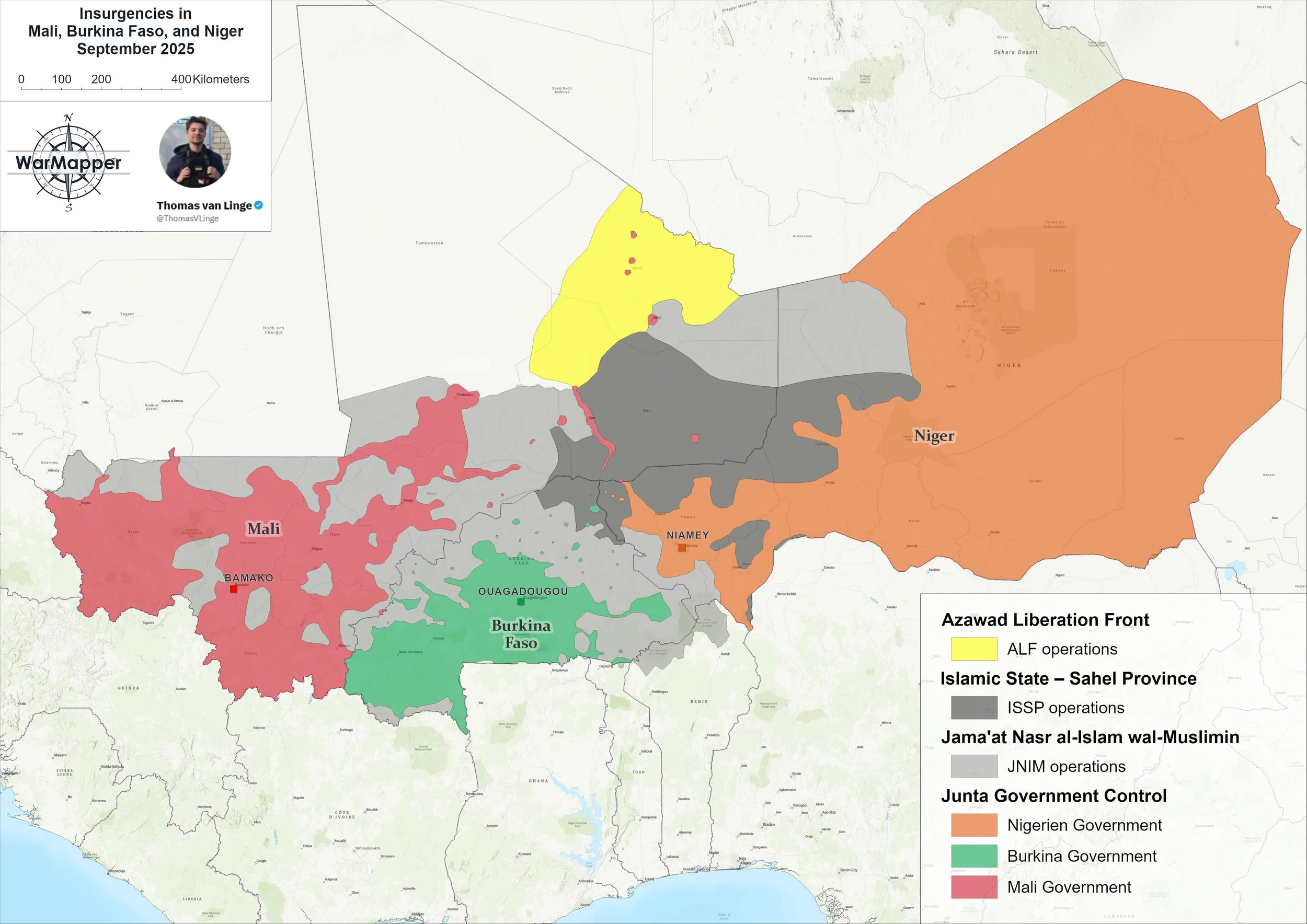
Reports that JNIM fighters have reached the outskirts of Bamako, combined with evacuation recommendations and orders from France, the United Kingdom, and others, have led to claims that the group is on the verge of capturing the capital.
But this perception comes from a misunderstanding of how JNIM operates. While the group does move freely across much of Mali and has recently carried out successful fuel blockades on the major routes to Bamako and other cities, it does not capture, control, or govern in a long-lasting way. JNIM will often announce the capture of military bases, but its fighters typically loot cash, weapons, and vehicles before withdrawing to strike elsewhere.
JNIM’s fighters are able to move across large parts of the country with little resistance. Outside of occasional patrols into rural areas, government troops and their allies largely remain inside military bases in the major towns and cities. It is key to note that the map above marks the areas where JNIM and ISSP primarily operate, not where they exercise control.
In the more remote areas of the country with little state presence, JNIM does collect taxes. Still, it is not an alternative government structure capable of replacing the state, unlike the parallel government system built by HTS in Syria. Despite losing ground in those rural areas since the withdrawal of MINUSMA and French forces, Mali’s government still controls most of the large population centres.
In the short term, it is unlikely that JNIM will attempt to seize control of towns or cities. Doing so would fundamentally change the nature of the conflict, forcing the group into more conventional battles. Their current strategy of ambushes and guerrilla warfare has proven effective, allowing them to overrun military outposts and capture equipment and funds to continue their insurgency. The fuel blockades have also supplied JNIM’s own forces while constraining the military and damaging the public perception of the junta further.
JNIM’s presence near the capital is not new. Attacks have occurred around Bamako before, and the current situation mainly raises the risk of ambushes and kidnappings. These risks likely explain the recent evacuation guidance, rather than any imminent collapse of the capital or the ruling junta.
Abbreviations:
JNIM: Jama’at Nasar al-Islam wal-Muslimin - the al-Qaeda group operating in the Sahel region.
ISSP: Islamic State Sahel Province - the Islamic State forces operating in Mali, Niger, and Burkina Faso.
HTS: Hay’at Tahrir al-Sham - the Syrian Jihadist paramilitary group, which formed the core of the Syrian caretaker government after defeating the Assad regime.
MINUSMA: United Nations Multidimensional Integrated Stabilization Mission in Mali - The UN mission to Mali, which ceased in June 2023 after being expelled by the junta.